Structural Analysis Case Study
Truss Design: 138 Iterations to One Odd Arch
Design the strongest, cheapest bridge truss the rules allow. We wrote our own MATLAB analysis program, picked a single metric (load carried per dollar of cost), and used it to work through 138 candidate designs before settling on a winner that looks a little strange.
The Metric Comes First
Strength and cost pull in opposite directions, so instead of chasing either one alone we optimized their ratio. To make that fast, we extended our MATLAB truss solver with two diagnostics: a force ratio for every member (member force over applied load, showing which members actually carry the structure) and a percent-of-buckling-strength figure for members in compression, showing how close each one is to failing.
Together they point at the critical member of any design, the one worth redesigning first.
Constraints Do the First Round of Design
Members had to be 8 to 15 inches long across a 34-inch span, with the load placed 19 to 22 inches from a support. Once you work those numbers, the bottom chord practically designs itself: four nodes, three members. A fourth member can't legally fit, and since the bottom chord is in tension anyway, splitting it further would add cost without adding strength.
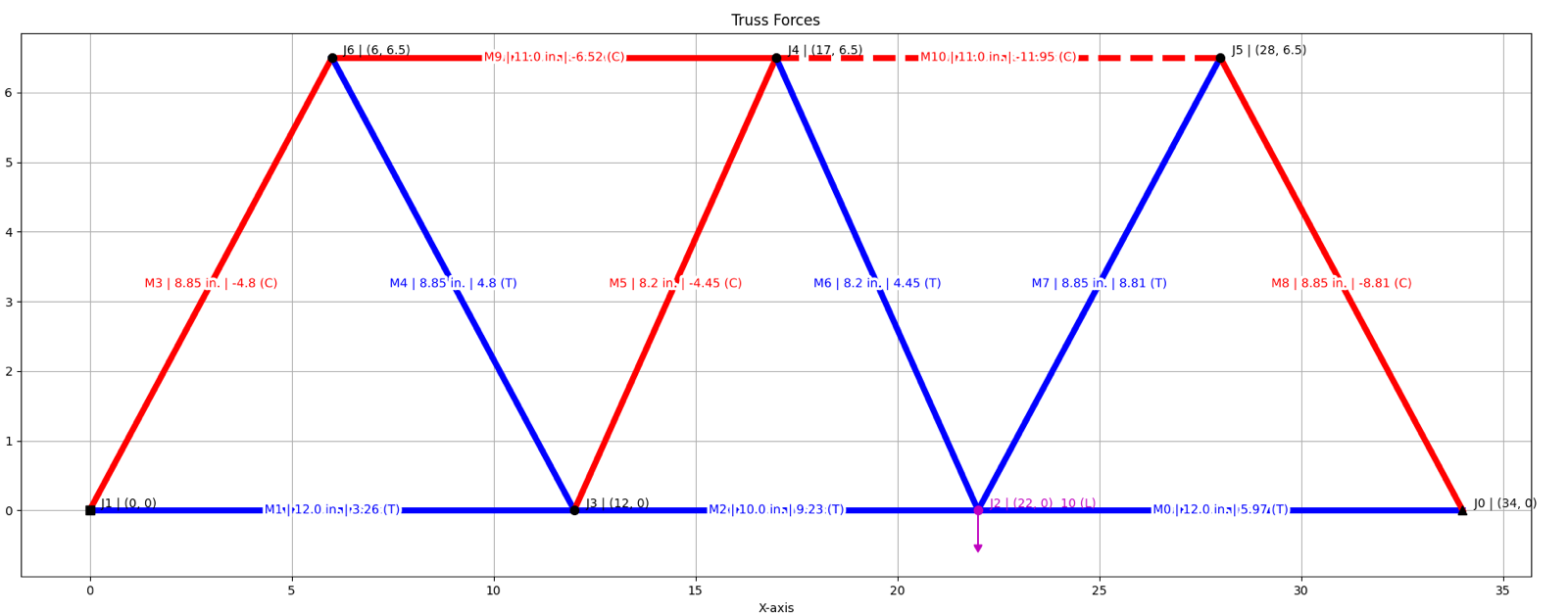
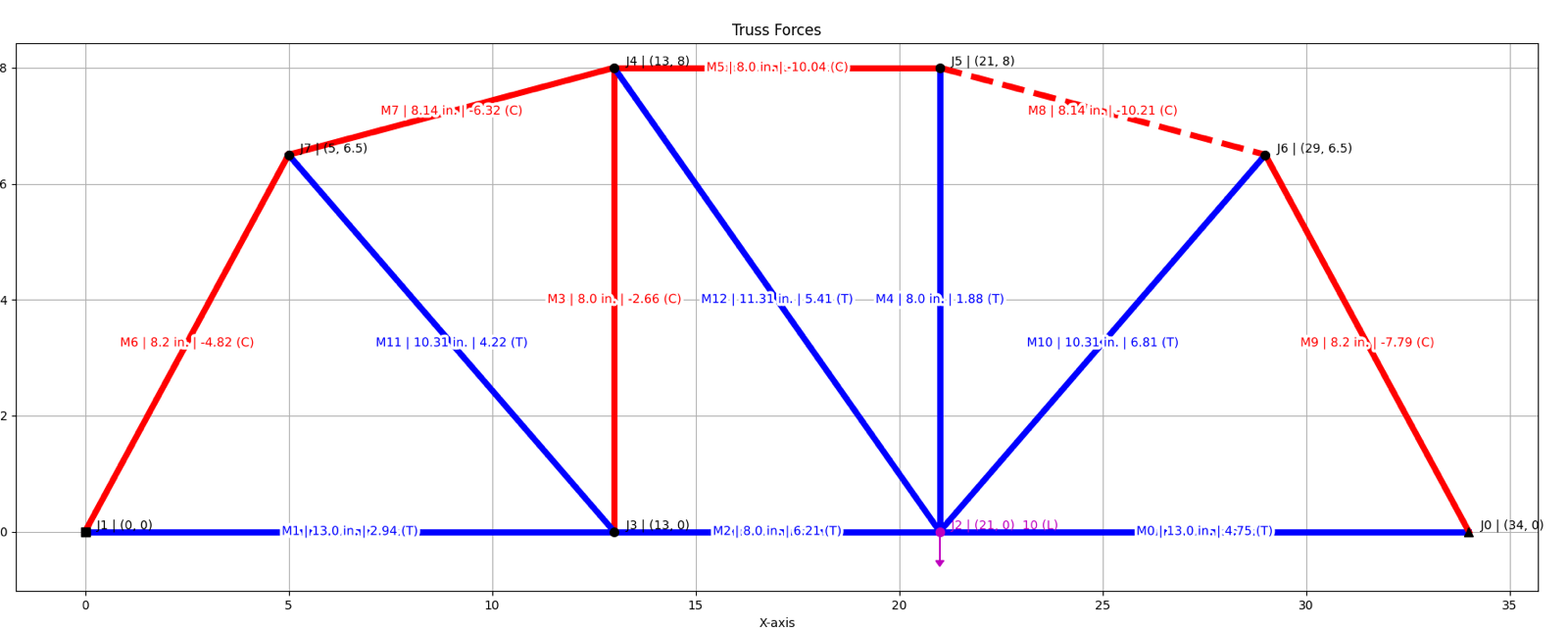
That left the top of the truss as the real design space. We sorted options into archetypes by node count and tested each. Tops with 1 or 6 nodes turned out to be geometrically impossible within the length limits, so we optimized 2 through 5-node designs and compared ratios. A pattern emerged: with more top nodes, the maximum load grew faster than the cost of the extra members. From then on, every effort went into 5-node designs.
The Iteration That Mattered
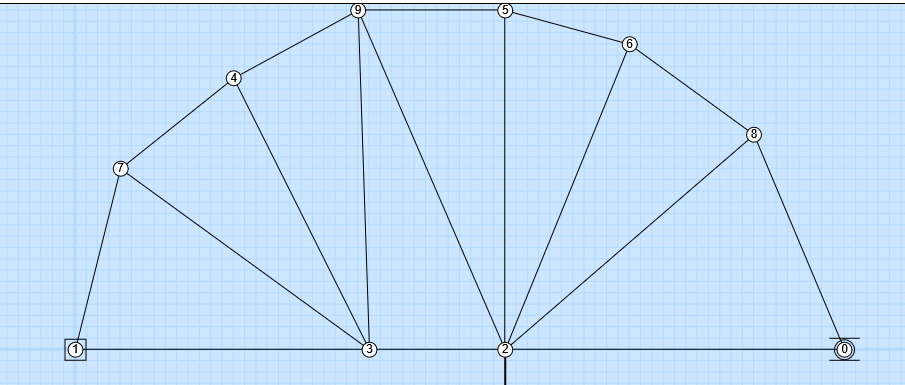
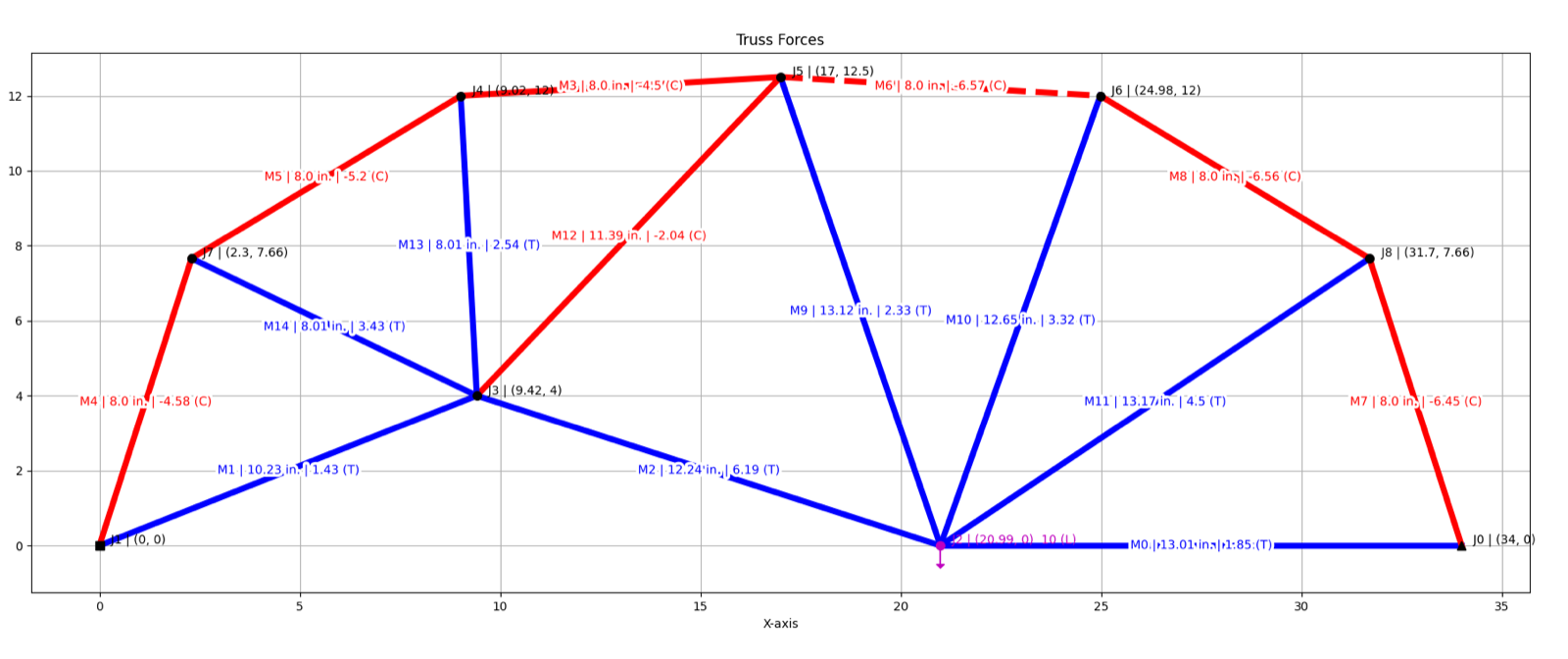
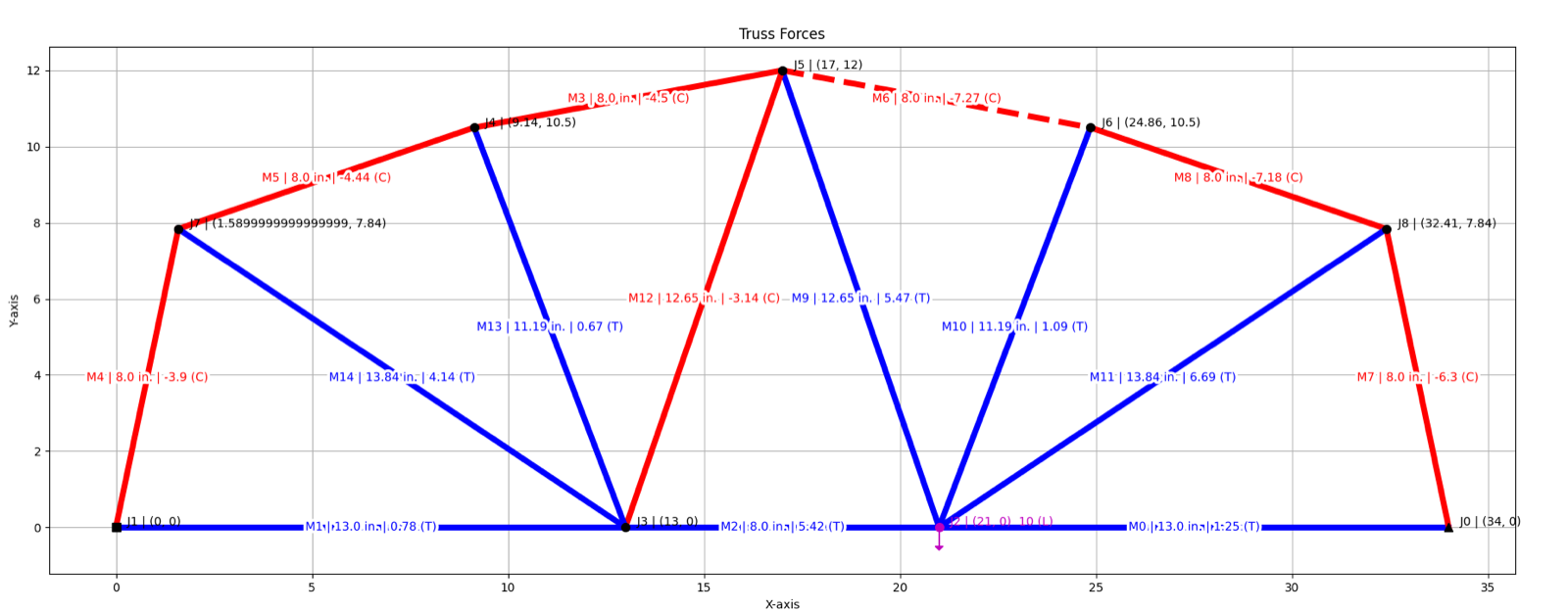
Our first optimized 5-node design scored 0.3195, with every compression member already at the 8-inch minimum and nothing left to shorten. The only lever left was force distribution. Borrowing the arch-like geometry from the impossible 6-node archetype raised the score to 0.333. Then a trade-off appeared: raising the center joint relieved force in two critical members but lengthened another one until it became the new weak point, and buckling strength drops off quickly as a member gets longer.
The fix was finding where the relief effect stopped helping (12.5 inches up) and pinning every other joint at the geometry that kept the newly critical member as short as possible. The result looks strange, and it scored 0.3808, the strongest and most efficient of all 138 designs we tested.
The ethics half of the project. Alongside the design work we studied the 1978 Hartford Civic Center roof collapse, a space-frame roof that failed under snow exactly where its trusted, untested computer model said it was safe. As recorder I documented our team's conclusions: simulation is a tool rather than a verdict, warning signs demand action, and someone has to own responsibility for the whole structure. It also reframed our own project, since our program's predictions were only as good as the assumptions we fed it.
What I Learned
- Optimization needs one honest number. Load-to-cost settled every design argument we had.
- Instrument your tools. The force-ratio and buckling diagnostics told us what to change, not just what would break.
- Tight constraints killed the classic Pratt, Howe, and K trusses, and pushed us toward a shape we would never have drawn otherwise. As we put it in the report, you can't think outside the box unless there's a box in the first place.
- After Hartford, I treat any unvalidated computer model as an opinion.